Having It All. In France. 100 Years Ago.
Turns out the work-life balance debate was raging in Belle Époque magazines, too.
At first blush, recent discussions about women “having it all” seem
to be uniquely American and of this time: the product of our
overachieving society, capitalism, and the constant pressure to succeed.
But it’s also a product of the mass media and its particular, visual
pressures upon women. This, then, is not a new phenomenon. It actually
originated more than 100 years ago in France, where both photography and
film were invented, and arguably celebrity culture as well (think Sarah
Bernhardt).

Photo courtesy Rachel Mesch.
Around the time that photographs of famous people were first starting
to circulate in French magazines, these magazines were also reimagining
how to present the modern French woman. In the early 1900s, rival
publications Femina and La Vie Heureuse (literally, The Happy Life) introduced the femme moderne,
a much more pleasing spectacle than her predecessors, who had for years
been the bicycle-riding, pants-wearing, cigarette-smoking,
husband-chastising “New Woman” (quite the media construction herself).
The femme moderne was a beautiful creature who could
perfectly—and joyfully—balance femininity and feminism, without so much
as breaking a sweat. All of a sudden, women’s progress was not about
making demands but about performance and possibility, evidenced by an
array of photographs that repeatedly demonstrated the elegant and
graceful ways that women were embracing modern roles. This offered women
a pleasing, affirming, and celebratory new way to see themselves— both a
great feminist strategy and a fabulous way to sell more magazines.
Corsets were already on their way out in 1911 when this ad appeared in La Vie Heureuse, coyly affirming the link between feminism and femininity at the core of the femme moderne
identity. This manufacturer advertised a gentler, healthier corset—the
product of the latest medical research—which would avoid “suffering or
wounds to internal organs” while offering perfect alignment.

Photo courtesy Rachel Mesch.
With rapidly evolving photographic technology, Femina was
able to feature images that represented impressive feats while
suggesting metaphorical possibilities. While this woman was actually
climbing a mountain, women readers were subtly urged to reach new
heights themselves.
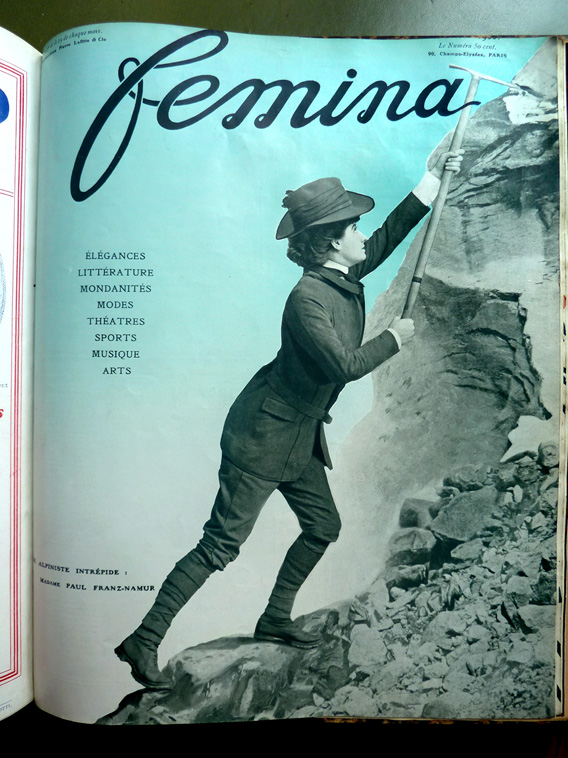
Photo courtesy Rachel Mesch.
Who says women are subject to vertigo? asks the caption. Here’s evidence to the contrary!
Like the mountain climber, this woman literalizes the message of female
achievement at the highest level and seems miraculously unhindered by
her flowing skirts.

Photo courtesy Rachel Mesch.
Sports journalism was all the rage in the 1900s, thanks to portable,
wide-angle cameras that could capture action shots. For the first time,
you didn’t have to attend an event to catch its highlights. Femina and La Vie Heureuse
frequently featured women athletes, appropriately dressed. This tennis
player looks happy, celebratory, and strong without losing her
femininity in the process.

Photo courtesy Rachel Mesch.
Roller skating was the hottest new sport for women in 1911. The expression on the face of this rinkeuse—a former dancer—as well as her graceful pose captures it all: She’s skating straight into a freer, more joyful future.

Photo courtesy Rachel Mesch.
Educational reforms in the late 1880s meant that more women were
entering professions than ever before, but there were still only a
handful of female doctors and lawyers. A later Femina article zeroed in on one of these young women, who chose her profession, bien sur,
in order to help other women and children. They described her as “tall
and thin, confident, and wearing a lovely red dress that fit simply
under her robe.”

Photo courtesy Rachel Mesch.
Driving was described in the magazine both as a sporty, modern
activity and a way to expand women’s domain beyond the homefront. And
while the independent, family-unfriendly New Woman was associated with
the bicycle—a vehicle rumored to cause both self-pleasuring and
infertility—the car had room for kids in the back.

Photo courtesy Rachel Mesch.
Royals were among the first celebrities. Readers loved to admire
their exquisite furniture and fashions but also to see that, as women,
they were “just like us.” Babies were the perfect equalizer—and really,
is there anything more compelling than the image of a queen giving her
son a piggy-back ride?

Photo courtesy Rachel Mesch.
On the other hand, it wasn’t enough to just be royalty
anymore. Even queens had to do more to impress a new generation of
achieving women. When the queen of Romania published a poetry collection
in French, she became a literary sensation. This issue of the magazine
announced the first of a series of writing contests that would lead to
the Prix Femina, distinguished by its all-female jury, and to this day is one of the most coveted literary awards in France.

Photo courtesy Rachel Mesch.
Female writers were among the magazine’s most beloved celebrities.
Media darling Lucie Delarue-Mardrus became famous because her husband (a
famous writer himself) had the good sense to send in photos of her in
exotic costumes while they were traveling in Tunisia—a natural hit for a
French public infatuated with the Orient. When she returned to Paris a
few months later with a new poetry collection, Delarue-Mardrus was
already in high demand.

Photo courtesy Rachel Mesch.
In 1909, the Académie française took up the question of electing female members. In the meantime Femina
asked readers to elect 40 women writers, past or present, to fill a
fictional female academy. This primitively photoshopped image imagines
the winners in the halls of the venerable institution. Despite the
optimism of the moment, a woman wouldn’t be elected into the Académie française until 1980(!).

Photo courtesy Rachel Mesch.
This striking cover by the beloved artist Paul Cesar Helleu
assimilated breast-feeding with traditional French elegance. Some of the
most popular women’s fiction of the time discussed the challenges of
nursing for the female professional. Sound familiar? In a 1909 novel, a
rising legal star runs off to nurse in between court sessions; in
another, the protagonist is a brilliant doctor whose child dies after
the nanny adds water to breast milk while Maman is off seeing patients.

Photo courtesy Rachel Mesch.
In spite of celebrated novelist Marcelle Tinayre’s slightly
awkward—and surely untenable!—pose, the caption on this photo leaves no
room for doubt on its intentions: “Between the started manuscript and
the child to whom she gives her hand, Madame Tinayre—even while
composing wonderful books— has maintained the very spirit of feminine
life—a tender heart, love for little ones, the taste for decorating her
home.” Compare this image with Tina Fey’s eerily similar American Express ad (which suggests what might happen if Tinayre let go). Plus ça change?
 Photo courtesy Rachel Mesch.

No comments:
Post a Comment